Let agents manage tags, Structured Q&A analysis, Modes are now enforced in chat, Attachments persist across modes, Focus narrowing is now an explicit step, “Research and cluster” mode is renamed to “Clusters”, Smarter PII redaction, Settings UX refinements
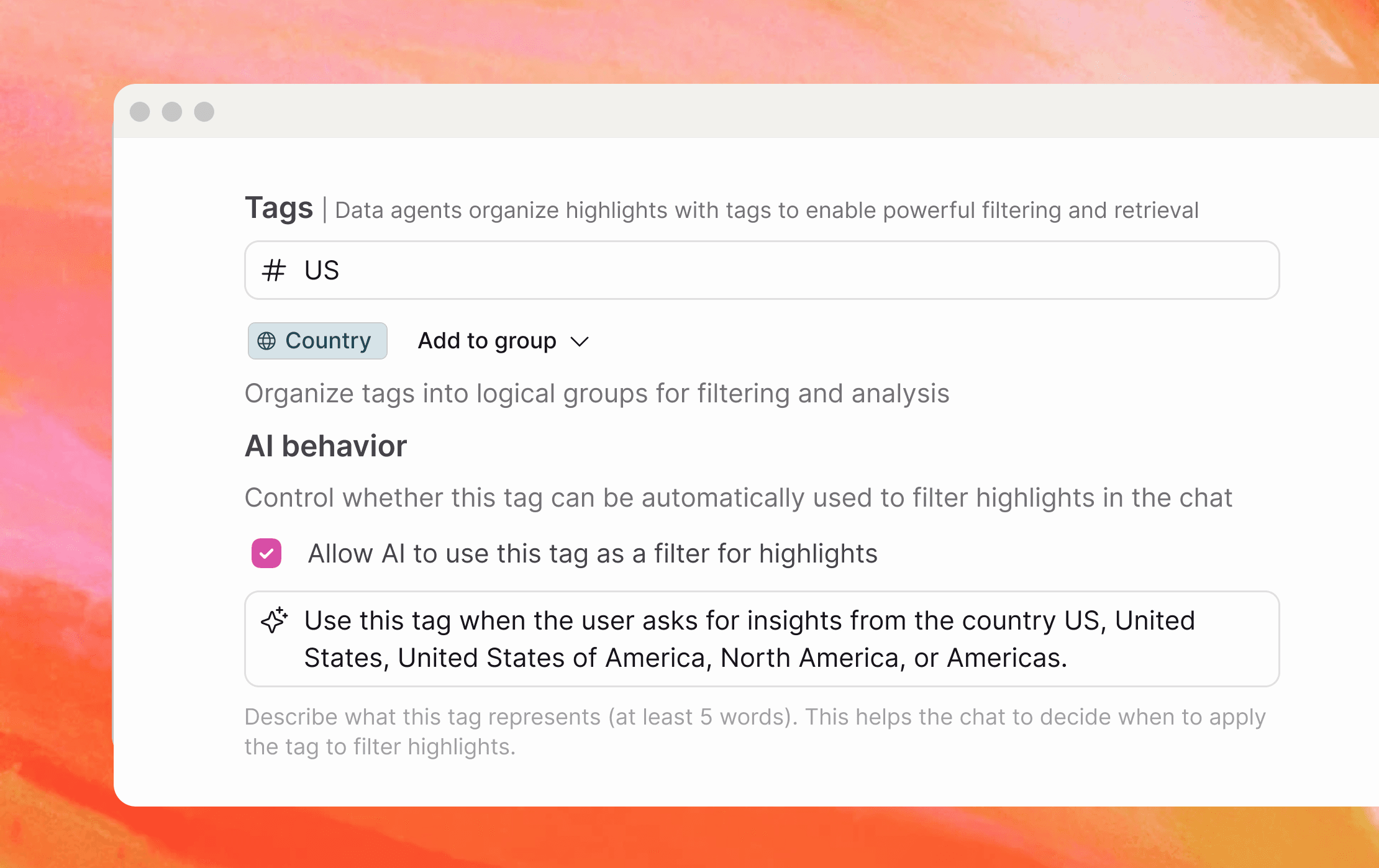
AI tag descriptions are now default on (opt-out)
Teams rely on Tags to narrow data and their focus in chat. To help our stack perform, tags now get an AI-generated description by default, with a clear opt-out if you prefer to manage descriptions yourself. This improves tag quality from day one and makes Focus behavior in chat more reliable. A backfill tool can generate missing descriptions for existing Tags.
Structured Q&A analysis (Beta)
Teams running structured interviews want Highlights that follow their interview guide, but generic extraction can lose the question-by-question structure. We added a new capabilities that detects Q&A blocks and turns them into Highlights that preserve the original format. This makes research outputs easier to review and analyze by question. The feature is currently in beta.
Modes are now enforced in chat
Users choose Modes to get a specific outcome. Now, when you select a Mode (Hypothesis, Clusters, Podcast, Presentation…), the AI agent will run that mode’s core workflow before responding. This makes results more predictable and ensures the outputs match the Modes you picked.
Attachments persist across modes
Uploaded files and selected sources are now sticky in chat, even if you change Modes in the same thread. Multi-message chats remain grounded in the exact same input data.
Focus narrowing is now an explicit step
We've upgraded the chat to now runs a dedicated propose_focus_change step before retrieving data, and that step is visible in both streaming and saved history — visible in Thinking. This makes it clear when Focus was set and why, so teams clearly see the data the AI agent is using to produce responses.
“Research and cluster” mode is renamed to “Clusters”
Users see “clusters” in the product and already use that language in conversation. We renamed the “Research and cluster” mode to “Clusters” to keep terminology consistent and reduce cognitive load.
Smarter PII redaction
We upgraded PII redaction models to better handle context and multilingual input, improving readability while still protecting sensitive information. As before, sensitive data is removed before anything is sent to external AI services.
Settings UX refinements
Creating a Job now opens it directly, Settings table selections are deep-linkable, tag creation respects the active group filter, group editing keeps your place, and teamspace switching shows clear loading states.